
As a technology consultant specializing in automation and integration of all things Advent, I have helped hundreds of firms make the financial reports and statements they envision a reality. In the past, those projects may have been slowed to some degree by the more obvious technical challenges: creating the mockups, subsequent report development, and testing/validation, but those aren’t the only things that make revamping statements time-consuming.

It is also what occurs within an organization as a precursor to any possible statement redesign and in tandem with an ongoing statement redesign that takes time. Changing statements requires that principals buy into the idea and believe that changing the statements, which very likely have been in use for many years, is a priority. Statement redesign doesn’t happen in a vacuum. Along the way, a lot can happen. These types of projects can be put on hold, as firms planning to update their reports may also be considering changing to another platform that might offer better reporting as a feature.
There are several factors that go into choosing a new platform, and I wouldn’t make a generalized recommendation related to that. However, if moving to a new platform is primarily about improved reporting, it is prudent to see what you can do with your existing platform before you change it.
Historical Mockups
Over the years, I have been provided with an assortment of exhibits cut out from other firms’ reports, sketched approximations of what the reports should look like, and entire report packages from other firms with a request to reproduce them. In the past, mocking up reports was something that could take hours or days. If a client didn’t already have something very specific in mind, I would provide them with report samples to review. Working from those samples as general ideas of what we could do, clients would create mockups of the reports they wanted.
Today, creating your next-generation report packages can be quicker than ever thanks to a wide variety of AI tools that are well-suited to the task. In some cases, you can create presentation-quality mockups in minutes. AI should not be used as a substitute for creative human thought and ingenuity, but working with AI tools undoubtedly speeds the process of taking your ideas and transforming them into a presentation-quality visualization that can be shared with your peers.
When done with the proper approach, tools, and infrastructure in place, you can go from having mockups to having live reports you can use in a fraction of the time it would have taken years ago, and you don’t need to change your PMS platform from Axys or APX to get these types of reports.
Data and Reporting Processes
The key is having the underlying data from Axys or APX in a modern data warehouse and access to qualified tech resources to update any additional queries and data feeds you may need for the reports you want to design. That infrastructure, along with workflows that leverage it, empowers you to own your data and reporting processes. The image below illustrates my chosen approach to providing high-end investment reporting solutions to investment professionals for many years.
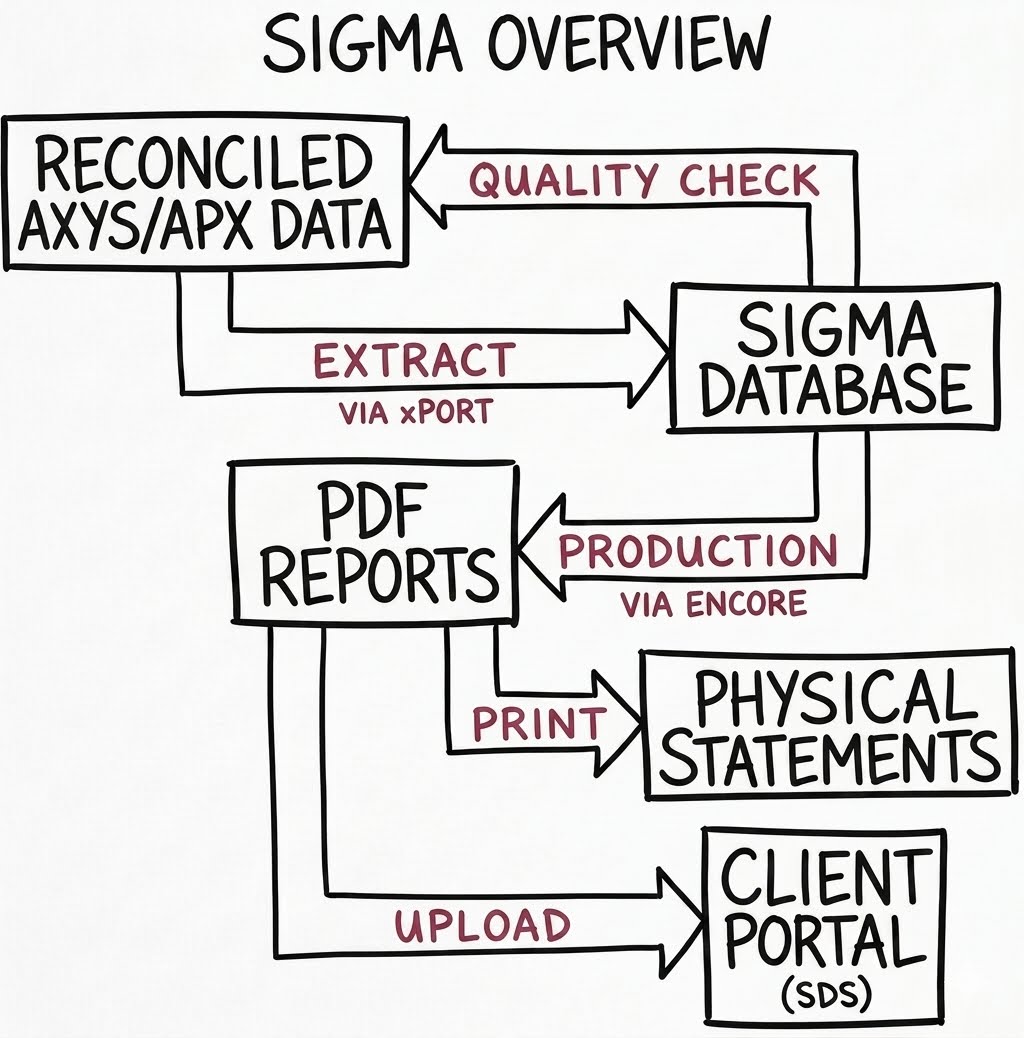
Next Gen Reports
While that fundamental approach hasn’t changed, the way we create reporting solutions has transformed with improvements in the technology available to us. Traditional report-writing tools could certainly be used to develop reports that are first produced as mockups, but it is no longer necessary. Instead, we can simply prompt the AI tool of our choice to create a program to populate the reports.
So long as you have the Advent data necessary to produce the reports in an acceptable database format, you should be able to populate the new reports almost immediately. If you don’t have the necessary Advent data in a data warehouse yet, that process has also never been easier than it is today. Advent subject matter experts like myself should expedite that process significantly and ensure that the data extracted is correct, but once again, AI tools are making ETL and data warehouse projects much easier than they have been in the past.
That said, pulling the data en masse is a larger, more complex project that, for now, may still be best left to those with specific expertise doing it. A data warehouse isn’t just a bunch of tables. The structure of the tables, queries, and relationships between them facilitates your ability to create additional queries and reports more efficiently.
Reports like the Portfolio Statement included in this blog are just a sample of what is possible. If you can imagine it and create a detailed system prompt describing what you want, AI tools like Claude can help you make it a reality.
There really is no time like the present to update your client statements.
 About the Author: Kevin Shea is the Founder and Principal Consultant of Quartare; Quartare provides a wide variety of agile technology solutions to investors and the financial services community at large.
For details, please visit Quartare.com, contact Kevin Shea via phone at 617-720-3400 x202 or e-mail at kshea@quartare.com.