Tag Archive: Automation


As a technology consultant specializing in automation and integration of all things Advent, I have helped hundreds of firms make the financial reports and statements they envision a reality. In the past, those projects may have been slowed to some degree by the more obvious technical challenges: creating the mockups, subsequent report development, and testing/validation, but those aren’t the only things that make revamping statements time-consuming.

This statement mockup was created in about five minutes using Claude. No data provided here is real.

It is also what occurs within an organization as a precursor to any possible statement redesign and in tandem with an ongoing statement redesign that takes time. Changing statements requires that principals buy into the idea and believe that changing the statements, which very likely have been in use for many years, is a priority. Statement redesign doesn’t happen in a vacuum. Along the way, a lot can happen. These types of projects can be put on hold, as firms planning to update their reports may also be considering changing to another platform that might offer better reporting as a feature.

There are several factors that go into choosing a new platform, and I wouldn’t make a generalized recommendation related to that. However, if moving to a new platform is primarily about improved reporting, it is prudent to see what you can do with your existing platform before you change it.

Historical Mockups

Over the years, I have been provided with an assortment of exhibits cut out from other firms’ reports, sketched approximations of what the reports should look like, and entire report packages from other firms with a request to reproduce them. In the past, mocking up reports was something that could take hours or days. If a client didn’t already have something very specific in mind, I would provide them with report samples to review. Working from those samples as general ideas of what we could do, clients would create mockups of the reports they wanted.

Today, creating your next-generation report packages can be quicker than ever thanks to a wide variety of AI tools that are well-suited to the task. In some cases, you can create presentation-quality mockups in minutes. AI should not be used as a substitute for creative human thought and ingenuity, but working with AI tools undoubtedly speeds the process of taking your ideas and transforming them into a presentation-quality visualization that can be shared with your peers.

When done with the proper approach, tools, and infrastructure in place, you can go from having mockups to having live reports you can use in a fraction of the time it would have taken years ago, and you don’t need to change your PMS platform from Axys or APX to get these types of reports.

Data and Reporting Processes

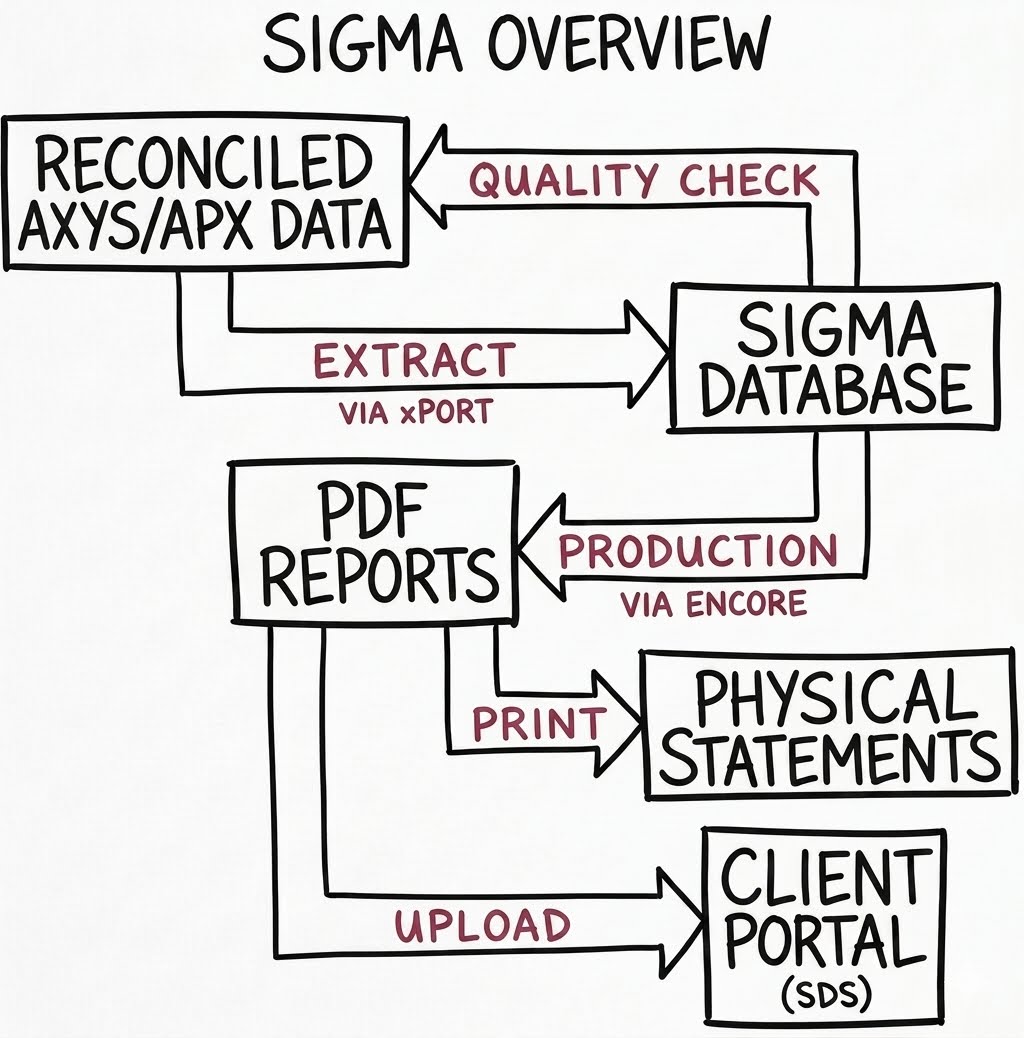
The key is having the underlying data from Axys or APX in a modern data warehouse and access to qualified tech resources to update any additional queries and data feeds you may need for the reports you want to design. That infrastructure, along with workflows that leverage it, empowers you to own your data and reporting processes. The image below illustrates my chosen approach to providing high-end investment reporting solutions to investment professionals for many years.
Next Gen Reports

While that fundamental approach hasn’t changed, the way we create reporting solutions has transformed with improvements in the technology available to us. Traditional report-writing tools could certainly be used to develop reports that are first produced as mockups, but it is no longer necessary. Instead, we can simply prompt the AI tool of our choice to create a program to populate the reports.

So long as you have the Advent data necessary to produce the reports in an acceptable database format, you should be able to populate the new reports almost immediately. If you don’t have the necessary Advent data in a data warehouse yet, that process has also never been easier than it is today. Advent subject matter experts like myself should expedite that process significantly and ensure that the data extracted is correct, but once again, AI tools are making ETL and data warehouse projects much easier than they have been in the past.

That said, pulling the data en masse is a larger, more complex project that, for now, may still be best left to those with specific expertise doing it. A data warehouse isn’t just a bunch of tables. The structure of the tables, queries, and relationships between them facilitates your ability to create additional queries and reports more efficiently.

Reports like the Portfolio Statement included in this blog are just a sample of what is possible. If you can imagine it and create a detailed system prompt describing what you want, AI tools like Claude can help you make it a reality.

There really is no time like the present to update your client statements.


About the Author: Kevin Shea is the Founder and Principal Consultant of Quartare; Quartare provides a wide variety of agile technology solutions to investors and the financial services community at large.

For details, please visit Quartare.com, contact Kevin Shea via phone at 617-720-3400 x202 or e-mail at kshea@quartare.com.

Schwab is no longer providing price file downloads that some Axys users have relied on for decades.

When I set out to write this, I had some trouble deciding on the title.  At first, I considered “Schwab Hamstrings Pricing for Advent Users”, but that’s inflammatory and not entirely accurate, so I couldn’t do that.

I could just as easily have titled this blog “Stubborn Axys Users Refuse to Embrace Benefits of ACD Interface” or “Axys Users Slow to Hire Consultants to Address Schwab Point-to-Point Interface Changes”, but in truth Schwab is discontinuing their support for Axys in the data they provide directly to their customers via the Schwab download, so I had to go with “Schwab Discontinuing Support of Axys Point-to-Point Interface – Again?”  Besides, picking one of those other titles would have made me write a blog with a different message.  In advance, I’d like to clarify that this issue only impacts the Schwab point-to-point interface and has no effect on those that receive their Charles Schwab data from Advent’s ACD interface. 

I need to apologize to those who have read my blog regularly in the past.  First, I am sorry I haven’t posted anything in a while.  Additionally, I must apologize that this blog may not seem particularly newsworthy for some.  You may even be thinking, Didn’t this happen eons ago.  The answer is yes and no.

About twenty years ago, there was some drama about the point-to-point interface that Charles Schwab provided to its customers and Advent, being Advent, may have been perceived as attempting to screw Charles Schwab and its customers to make more money.  Schwab, being Schwab, sued Advent – to paraphrase the judge told Advent, “You can’t do that.”

According to what I can dig up now, the firms quit wasting each other’s time and money nearly seven months after that preliminary injunction, coming to a compromise that allowed Schwab to continue to provide their point-to-point data for a period of time.  In my recollection of the events, it seemed much more drawn out.  Fast forward twenty years, and now everyone that is still relying on this particular set of data directly from Schwab’s download is back to square one.

Back in 2002, the underlying issue was that Advent didn’t want Schwab to continue providing the data without going through ACD and Schwab wanted to continue providing the data to satisfy their existing customers, who had grown dependent on getting that data via the point-to-point interface.  From the perspective of those Axys customers, it is easy to understand their position then and now…  it is pretty much free, and it works.  Why would we want to change that?

Somehow, for more years than I would have thought possible these holdouts that either saw no reason to fix something that wasn’t broken or were too cheap to move to ACD continued to do what they had been doing for decades.  I never thought this would have gone on as long as it did.  Alas, as they say, all good things must come to an end.  That is apparently what is happening now.

Schwab is in the process of stopping production of the files that feed Dataport for this subset of Axys users.  Last month, they stopped producing the price (CSMMDDYY.pri) files; they are also planning to stop producing other key files, such as transactions, sometime in 2023.  The sudden inability to create a price file no doubt caused some difficulties for those still dependent on them.  As a result, a couple firms reached out to me.

After a brief discussion with the first firm, I agreed to automate the creation of the missing price file.  According to my customers, both Advent and Schwab were unwilling to assist them with the issue.  Advent’s not planning to make changes to their interface to take in the new Schwab files, and Schwab’s not planning to help clients transform the files into something that can be ingested directly into Dataport.

It sounded way too easy for someone with my experience, and I thought it would only take a “few” minutes.  Somewhat embarrassingly, I spent a few hours creating the automation necessary to do the translation.  However, in a subsequent implementation for another customer, I was able to have a meet-and-greet call with them and a follow-up call to implement and test the solution in their environment very quickly.  All of it was accomplished in a couple hours, and on the very same day the prospective customer contacted me, leading me to believe that future implementation may be performed in a matter of minutes.

Those dealing with what is currently limited to a pricing issue have a handful of choices, none of which are fun to deal with when you need yesterday’s prices now:

  1. The most obvious choice: consider implementing the Schwab Interface via ACD.  It might be worth it.  I am not kidding.  I have plenty of clients that use ACD.
  2. Use a third-party pricing service like IDC/ICE or Telemet.
  3. Key the prices in manually.  I am not recommending this, but it is certainly an option.
  4. Utilize automation to recreate the missing price file (CSMMDDYY.pri) from the security file (CRSYYYYMMDD.SEC) now provided by Schwab.  This isn’t very difficult, and that is what I have done for those who have asked me to resolve the issue for them.

Addressing the pricing issue alone is a stop-gap solution at best.  The larger issue down the road is translating the transaction files, which will need to be done in 2023.  At my clients’ request, I have agreed to look into doing this for them as well, and I will most likely do it.  With my experience building Axys interfaces and doing the requisite transaction mapping et cetera it probably won’t be that big a deal, but it will certainly be more complicated and time-consuming than the Price File Translator was to create.

As always, if this issue is something your firm needs assistance with, please feel free to contact me directly.


Kevin Shea Impact 2010

About the Author: Kevin Shea is the Founder and Principal Consultant of Quartare; Quartare provides a wide variety of technology solutions to investment advisors nationwide.

For details, please visit Quartare.com, contact Kevin Shea via phone at 617-720-3400 x202 or e-mail at kshea@quartare.com.