Earlier this year, when software stocks were taking a beating related to the heights of AI enthusiasm, a client reached out to me for my opinion on whether AI might be used by domain experts, such as myself, to create competing products capable of supplanting established software firms like Advent and others at a fraction of the price due to a lower cost base.
At the time, I acknowledged that it was possible, but more likely to happen at smaller firms. Investment professionals are stereotypically risk-averse in their business practices and the production software they utilize to run their businesses. While the largest investment firms are better suited to tolerating risk from a resource standpoint, they are also the least likely to take on what they might consider unnecessary risk. As a result, larger firms as a whole are slower to replace mainstream products with upstart offerings that have an unproven track record.
However, a more likely possibility has emerged: firms currently running vendor software—motivated by the costs and limitations of those products—may simply create their own systems using AI to aid them in the process. I have already seen signs that some firms are doing this and feel comfortable doing so. I am not necessarily recommending it, but I understand the motivation.
If you are paying substantial fees for systems you believe you could replace, why wouldn’t you? The key here is understanding what these systems actually do. A vendor with a forty-year track record has built a product that almost certainly handles details that an AI-assisted or ‘vibe-coding’ alternative (with a relatively short window of development and testing) does not; however, that may not matter much if you are only looking for 60% to 80% of the functionality of the product you are replacing.
When I compare products in the investment space, there are clear differentiators between older-class solutions and newer-class solutions. Those differentiators once would have represented a significant hurdle for a competing product to match, but AI makes it much easier.
As an example, consider the HTML attachment below, which summarizes hypothetical investments for a fictitious company and client in a format typical of newer-class solutions. I used Claude to help me produce this last month. This is something I could have done previously if a prospective client had asked me to, but I was never tempted to do so because it would have been tedious and time-consuming to perform manually. With the assistance of frontier AI models, I was able to achieve the following result, which can easily be populated from portfolio accounting data within Axys or APX. Please note that all reporting exhibits in this blog were produced using Anthropic, OpenAI, and Perplexity models and based on fictional data; disclosures on each exhibit also restate this.
The prompt was the result of a test I performed one afternoon where I asked the best-known publicly available frontier models in the cloud, as well as the best local models I can run on my Alienware Area-51 desktop, to create what I consider to be a decent report package by today’s standards. I would love to take more credit for it, but I cannot; I simply asked Claude to do it and it was done. Perplexity also did a respectable job, though it fell slightly behind Claude’s effort, while ChatGPT’s report was clean but relatively simplistic.
The local models didn’t put up much of a fight, although I may be able to improve their performance by using frontier models to design the prompts for them. It would be nice to rerun these tests using GLM-5.3 Q4 or GLM-5.3-Flash on a Mac Studio with an M5 Ultra chip and 512GB of unified memory, but I don’t have one of those yet. Naturally, if you write better prompts than I did or possess superior hardware, your results may vary.
Claude didn’t just create a pretty mockup of data in HTML like ChatGPT and Perplexity; it created JSON blocks within the HTML that I can populate programmatically from data feeds I have already created using xPort with Axys and APX. If I wanted to build an alternative system, I would be well on my way with this type of reporting right out of the gate.
Here is what I produced with Perplexity’s assistance.
The pros and cons of building versus buying remain. AI can potentially help you maintain the code, but will your staff truly understand everything they are using? Probably not. And what will it cost to maintain that code in the future? If the system is predominantly AI-coded and not fully understood by those at your firm, that cost will be determined by the “AI gods” in power at the time.
Can a true domain expert with deep knowledge of specific software utilize local and/or frontier models to build a competing system in a fraction of the time and cost required years ago? Yes. Absolutely—and every day, it is becoming more feasible.
About the Author: Kevin Shea is the Founder and Principal Consultant of Quartare; Quartare provides a wide variety of agile technology solutions to investors and the financial services community at large.
For details, please visit Quartare.com, contact Kevin Shea via phone at 617-720-3400 x202 or e-mail at kshea@quartare.com.
As a technology consultant specializing in automation and integration of all things Advent, I have helped hundreds of firms make the financial reports and statements they envision a reality. In the past, those projects may have been slowed to some degree by the more obvious technical challenges: creating the mockups, subsequent report development, and testing/validation, but those aren’t the only things that make revamping statements time-consuming.
This statement mockup was created in about five minutes using Claude. No data provided here is real.
It is also what occurs within an organization as a precursor to any possible statement redesign and in tandem with an ongoing statement redesign that takes time. Changing statements requires that principals buy into the idea and believe that changing the statements, which very likely have been in use for many years, is a priority. Statement redesign doesn’t happen in a vacuum. Along the way, a lot can happen. These types of projects can be put on hold, as firms planning to update their reports may also be considering changing to another platform that might offer better reporting as a feature.
There are several factors that go into choosing a new platform, and I wouldn’t make a generalized recommendation related to that. However, if moving to a new platform is primarily about improved reporting, it is prudent to see what you can do with your existing platform before you change it.
Historical Mockups
Over the years, I have been provided with an assortment of exhibits cut out from other firms’ reports, sketched approximations of what the reports should look like, and entire report packages from other firms with a request to reproduce them. In the past, mocking up reports was something that could take hours or days. If a client didn’t already have something very specific in mind, I would provide them with report samples to review. Working from those samples as general ideas of what we could do, clients would create mockups of the reports they wanted.
Today, creating your next-generation report packages can be quicker than ever thanks to a wide variety of AI tools that are well-suited to the task. In some cases, you can create presentation-quality mockups in minutes. AI should not be used as a substitute for creative human thought and ingenuity, but working with AI tools undoubtedly speeds the process of taking your ideas and transforming them into a presentation-quality visualization that can be shared with your peers.
When done with the proper approach, tools, and infrastructure in place, you can go from having mockups to having live reports you can use in a fraction of the time it would have taken years ago, and you don’t need to change your PMS platform from Axys or APX to get these types of reports.
Data and Reporting Processes
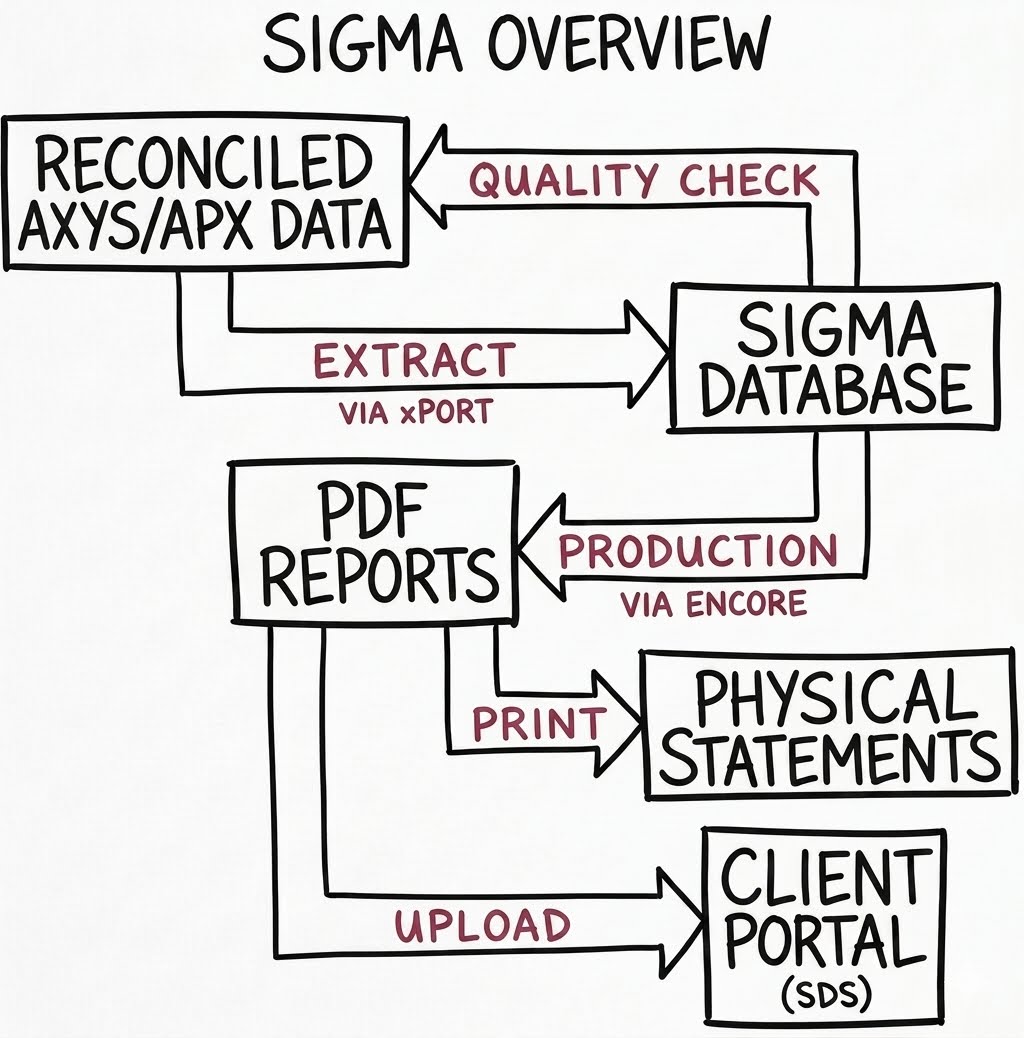
The key is having the underlying data from Axys or APX in a modern data warehouse and access to qualified tech resources to update any additional queries and data feeds you may need for the reports you want to design. That infrastructure, along with workflows that leverage it, empowers you to own your data and reporting processes. The image below illustrates my chosen approach to providing high-end investment reporting solutions to investment professionals for many years.
Next Gen Reports
While that fundamental approach hasn’t changed, the way we create reporting solutions has transformed with improvements in the technology available to us. Traditional report-writing tools could certainly be used to develop reports that are first produced as mockups, but it is no longer necessary. Instead, we can simply prompt the AI tool of our choice to create a program to populate the reports.
So long as you have the Advent data necessary to produce the reports in an acceptable database format, you should be able to populate the new reports almost immediately. If you don’t have the necessary Advent data in a data warehouse yet, that process has also never been easier than it is today. Advent subject matter experts like myself should expedite that process significantly and ensure that the data extracted is correct, but once again, AI tools are making ETL and data warehouse projects much easier than they have been in the past.
That said, pulling the data en masse is a larger, more complex project that, for now, may still be best left to those with specific expertise doing it. A data warehouse isn’t just a bunch of tables. The structure of the tables, queries, and relationships between them facilitates your ability to create additional queries and reports more efficiently.
Reports like the Portfolio Statement included in this blog are just a sample of what is possible. If you can imagine it and create a detailed system prompt describing what you want, AI tools like Claude can help you make it a reality.
There really is no time like the present to update your client statements.
About the Author: Kevin Shea is the Founder and Principal Consultant of Quartare; Quartare provides a wide variety of agile technology solutions to investors and the financial services community at large.
For details, please visit Quartare.com, contact Kevin Shea via phone at 617-720-3400 x202 or e-mail at kshea@quartare.com.
Gamers are having a rough go of it this year and understandably feeling betrayed by one of their long-time hardware darlings, Nvidia. As you may have heard, Nvidia and other companies like Micron are prioritizing the needs of big business’ AI requirements over gamers and consumers that don’t wield as much sway over their bottom line. This blog post isn’t going to make gamers-at-large any happier, but in my defense, this really isn’t anything new. For as long as I can remember, I have considered buying a decent GPU for a new desktop PC a prudent and reasonable business expense.
Early on, the GPUs I purchased were intended to ensure support for multiple monitors, but as the technology required to support multiple monitors became ubiquitous, I continued to buy GPUs for special circumstances where I knew users like me could benefit from enhanced GPU processing. If you value your time and that of your fellow employees and clients, you need to champion investments that empower and facilitate your team’s ability to not only meet ongoing technology challenges but also provide them with the tools that will enable them to exceed expectations in the future.
There is perhaps no better example of this than the implementation of AI at your office, and I am not talking about using an AIPC with Copilot. I mean real-world implementation: running multiple local LLMs simultaneously, LLM orchestration and coding agents (e.g., Claude Code), building and using AI agents (e.g., OpenClaw), using, creating and hosting MCP servers, implementing REST API integration, et cetera. While AI cloud resources, such as frontier foundation models operating within AI factories, can be dramatically more powerful and appear less expensive than purchasing local hardware, the larger issue of data privacy is the elephant in the room. For me, this issue is twofold: I cannot put my intellectual property or any part of my clients’ private data at the mercy of what may turn out to be false security promises as AI use agreements with providers continue to evolve.
The overriding concern of data security puts users in a situation where they are limited in what they can do while using cloud resources. Users may not feel comfortable attempting certain things on cloud resources due to concerns over security, and rightly so. The answer to these concerns is clear AI use policies and systems – that dictate acceptable use of cloud and local AI resources. Those same policies and systems should simultaneously facilitate the ability to use AI in productive ways and enforce data security without handicapping technological progress. AI is not the be-all and end-all of productivity, but it can be a valuable tool when used responsibly.
Apple Intelligence’s handiwork via Playground clearly illustrating why we need to check AI work.
Game-Changing Technology
It is easy to ignore minor changes in processing power year to year, but when true paradigm-shifting tech becomes available and affordable, we need to act on it. This is the thing that makes me buy new hardware. The Nvidia GeForce RTX 5090 (“5090”) and hardware of its ilk are game-changing. Their affordability may be debatable, but if you aren’t able to use them, or superior tech options, you are operating at a technological and competitive disadvantage to your peers. With these issues in mind, I strongly recommend systems on par with the Alienware Area-51 Gaming Desktop (model AAT2265) or better for complex local AI use cases.
Six Reasons to Consider Buying the Dell Alienware Area-51 Gaming Desktop for Local AI Use Cases
CPU – The AMD Ryzen 9 9950X3D CPU has excellent single-thread processing speed, superior multithreaded processing speed, and a large cache. It offers power without compromise. One of my aims when purchasing a new desktop is to never have to upgrade the equipment during the life of the purchase, and that should be possible with this system. There is an option to get an Intel Core Ultra 9 285K, but I am not a huge fan of using the Arrow Lake architecture for AI. Additionally, being able to select a PCIe 5 NVMe for primary/OS storage means that you can remove the most obvious remaining local processing speed bottleneck.
Market forces – The expectation of constrained future supply due to AI data center demands taking precedence over SMBs and consumers makes buying now more appealing than waiting until later, when scarcity and corresponding increased demand could impact buying power.
5090 availability – This local LLM beast facilitates private use of decent-size LLMs (30B parameter models run very fast; 70B parameter models are useable.). AI is a tool we use to get our jobs done as efficiently as possible. This is simply a cost of doing business. There are other options, but this is currently the fastest GPU you can buy short of enterprise-level hardware, where the cost increases significantly. Due to 5090 availability issues, buying the GPU bundled in a PC gaming build may be the easiest way to get one.
Competitive pricing – Dell’s Alienware pricing is reasonable given the current premiums on 5090 GPUs. You could get similarly configured gaming Desktop PCs for considerably less, but the Alienware price point offers superior build quality. You could also spend a lot more money buying similarly configured “workstation” hardware, which might provide a better upgrade path, but you would likely be paying enterprise prices.
Silence and build quality – When you set it up you should notice a deafening silence in comparison to similar systems. The case is extremely well-designed to keep the system cool and quiet.
Onsite support and hardware/driver continuity – You can be confident that Dell will show up to service the PC if needed. It weighs a ton. Nobody from your office will want to carry it anywhere for service… ever. Dell is also very good at making updated drivers available when they become necessary.
The latest Area-51 build has been out since January of 2025 in Intel CPU options, but Dell added AMD options to the configuration in November of 2025. Based on my experience, even though Dell quoted shipping at roughly a month, they shipped it quicker. The system I ordered in early January 2026 arrived in less than two weeks. It comes with a single year of onsite support, but I added three years to it, and if you buy one, you probably should too. For those curious about the benchmarks, I ran PassMark’s PerformanceTest on it and have included the results below.
Dell Alienware Area-51 Gaming Desktop (model AAT2265) Passmark PerformanceTest results. Compare your PC here.
The Evolution of Local AI Use Cases
Back in 2020, during the crypto boom, I bought a Nvidia GeForce RTX 2060 Super GPU with 8GB VRAM, which cost $500 at the time. It is not a barnburner by today’s standards, but it can run the OpenAI/gpt-oss-20b model well enough on LM Studio. I also have a notebook with an NVIDIA GeForce RTX 4060 Laptop GPU. That too has 8GB of VRAM and can run local LLMs way faster than the old desktop.
These systems enabled me to run, use, and test local LLMs to a certain point, but the results weren’t fantastic. I am short on patience when it comes to waiting for computers to do things. As I tried increasingly complex models and tasks locally, I reached some predictable limitations: context, first token, and tokens per second. Watching my computer render characters in slow motion while using larger LLMs made me wonder how much of a difference running those same models on a 5090 would make. The difference is night and day. I have zero regrets about this purchase.
One interesting takeaway from the experience of using the 5090 and running many tests between the various systems I have is that model results can change when it is run on different hardware. Ideally, they won’t, but your hardware affects how the model is executed by a local AI model runner, which can influence its output. For example, I ran the same version of LM Studio with identical models and settings to provide both my old and new desktop systems with the same prompt. Logically, you might think that you would get the same results, but in fact you get different results.
The result from my old desktop was terse and simple, while the result from my new desktop was comprehensive. Though I theoretically understand how AI works and could have anticipated some differences between the results due to the variability of calculations between hardware, I was admittedly surprised. Seeing the difference firsthand adds context to my understanding.
I wanted to attribute this positive difference to my faster hardware, but that would be incorrect. Mathematically speaking, the output is simply different because the hardware is different, and the fact that the response is comprehensive on my new desktop should be purely coincidental. On closer inspection, the model I used (OpenAI/gpt-oss-20b) likely ran the prompt under constraints when it was run on the 2060 Super with 8GB VRAM. That would have caused GPU offloading (since the model size is 12GB), noise, and numerical degradation in calculations. Those issues likely created a bias towards a less comprehensive answer.
Moving Forward
Given the opportunity cost, ongoing demands of AI data centers for PC memory, storage and GPUs, and a perceived scarcity issue that will persist for years, now seems like a better time to purchase a 5090 than later when it may not be possible. Please note this computer makes sense for me and other power users that can benefit from having a 5090 for local AI use cases, but it wouldn’t be a good choice for users that don’t fit that profile. If you are interested in learning about using local AI resources almost any Nvidia GeForce RTX 50 series GPU with at least 8GB VRAM could be a good starting point.
In the PC/GPU world, VRAM ultimately determines how large a model you can use fully on the GPU and how many models you can use simultaneously. A larger model size typically corresponds with greater training depth, capability, and sophistication, which often equates to less iterative work and greater user productivity in the end. When you run out of VRAM, your system attempts to compensate by offloading portions of the model to RAM and CPU (aka GPU offloading), which slows down processing noticeably due to lower bandwidth and higher latency. If you attempt to use more total memory than is available, the model may fail to load or the system may slow dramatically.
Using a Mac with unified memory instead of a PC with a discrete GPU removes the hard VRAM boundary and reduces the performance cliff associated with GPU offloading, but you are still limited to whatever unified memory your Mac has. Assuming you can fit the model(s) in use and their associated KV (Key-Value) cache — which scales with context length — into the 5090’s 32GB of VRAM, your typical Mac isn’t going to outperform a 5090 in raw inference speed.
If you are serious about working with AI locally, you may want to step up to a Nvidia GeForce RTX 50 series GPU with at least 16GB of VRAM, which would provide a longer runway for experimentation. Either option (8GB or 16GB) shouldn’t break the bank compared to a 5090. Buying a cheaper GPU will allow you to work with local AI resources and become familiar with the tools, but if all goes well, you may wish you purchased a 5090 GPU or something capable of running even larger models concurrently, such as a high-end Mac Studio (M3 Ultra).
About the Author: Kevin Shea is the Founder and Principal Consultant of Quartare; Quartare provides a wide variety of agile technology solutions to investors and the financial services community at large.
To learn more, please visit Quartare.com, contact Kevin Shea via phone at 617-720-3400 x202 or e-mail at kshea@quartare.com.
I have said it before, and I’ll say it again: if Advent does well, it follows that someone like me should do well, too. I profit directly from Advent customers when they hire me, and indirectly when companies that provide services to Advent customers hire me. That said, there is a certain amount of Advent’s dysfunction that helps my business. In short, I offer what Advent cannot and/or does not want to provide to their customers, and many of my customers hire me specifically because I do not work for Advent.
Steeplechase race in 1912, Celtic Park, N.Y., through water
On the other hand, there is a limit to what is reasonable. If Advent proverbially lights their hair on fire and jumps off a tall building, that is not good for me or my business. With thirty-five years of experience dealing with Advent, acting as an advocate to clients, I have seen some absurd things and have a high tolerance for some of it, but even I will occasionally find myself flummoxed. It pains me to say so, since I really want Advent to succeed… at least enough that they aren’t losing business to competitors without good reason. That is bad for their business and mine.
Advent Options
If you are to believe the natural progression of things as they are presented to the masses, it follows that some Axys customers who are frustrated by its limitations can be better served by Black Diamond or APX. From what I have seen personally, Advent hasn’t had great success moving Axys customers to Black Diamond. I have seen a few good Axys clients go Orion and Tamarac, but I have yet to see one of my clients go to Black Diamond successfully. This is not meant as a criticism of Black Diamond – it’s just an observation that my typical clients haven’t found the complete solution they are looking for in Black Diamond.
For those firms where Axys is no longer the answer and Black Diamond cannot meet their expectations, APX may offer a viable upgrade path. Aside from its cost, APX has always been a relatively easy upgrade choice for Axys users to make because it is an Advent option that supports the legacy of Axys, which includes knowledge of portfolio management and performance fundamentals, transactions, processes, reporting, and scripts. That means that when those customers move to APX, much of the reporting, infrastructure and established workflows can remain the same.
In short, APX offers everything that Axys does, plus the benefits of an Enterprise/SQL server platform. The incremental learning required for operations staff to go from Axys to APX is very manageable, and things pretty much work like they did in Axys.
Among APX offerings, I know of at least five possible permutations:
APX Self-Hosted on Premise
APX Self-Hosted in the Cloud by a Third Party
APX Dedicated with AOS
APX Dedicated without AOS
APX Multi-Tenant (hosted by Advent)
I have listed these APX environment options in order of my personal preference, based on specific experience with all of the options and the ease with which one can effectively manage, integrate, automate, and enhance systems. From my perspective, the first two options clearly give you the greatest degree of control and autonomy over your own systems. Choosing one of the other three options puts you in a place where Advent is enforcing various controls over your system – good and bad. Firms that have always had complete control over their systems and want to continue to do so should bristle at the very idea of this.
Advent’s Dedicated Hosting Service for APX Users
One that is used to hosting their own APX system on premise might think that hosting via Advent’s dedicated environment would be nothing but a boon, but reality quickly shatters that dream for savvy, hands-on APX users. Advent’s value add here is clearly AOS, but if that is the case, why would they ever sell someone dedicated hosting without the AOS service? When they do that, the Dedicated Hosting service provided is arguably no better than what a third-party vendor can deliver. Oh, wait, that’s not true. It is potentially worse, because the system will be locked down in such a way that you won’t be able to do the things you would be able to do if your APX hosted environment was provided by a third-party resource that needed to make sure you were satisfied with their service.
This is because, without an AOS resource, some things that a firm would want to do to automate and enhance their systems simply cannot be done because they fall under the responsibility of the AOS silo. You can call Advent support all you want, but they cannot resolve your problem, because only AOS can do these things.
Want to schedule a process to run at a certain time? You can’t do that. Do you want to install a third-party product? You can’t do that. Do you want to log into the server directly? You can’t do that either. All of these things are only possible with the cooperation of an assigned AOS resource. And even if you have an AOS resource, you still cannot do those things, but instead must ask your AOS resource.
A fitting analogy for comparing the work required in their locked-down environment to what one might otherwise do in a self-hosted environment could be comparing the 100-yard dash to steeplechase. As a result, the automation that you may create is more likely to resemble a Rube Goldberg machine than a typical streamlined process due to Advent’s forced assistance and rules regarding what can and cannot be done.
Unfortunately, as you invite a higher degree of involvement from Advent vis-à-vis Advent’s dedicated (a.k.a. “managed”) hosting model, you lose control of the systems you are entrusted to manage and improve unless you had the foresight to have Advent agree upfront to the access rights required or are willing to spend countless hours dickering with Advent about the rights, which may ultimately end in frustration anyway. This comment is not based on my direct experience with these systems alone, but also what I have heard amongst my peers.
Advent basically has the keys to the kingdom in this scenario, and the users are at the mercy of Advent. It’s almost plausible that they cannot allow you access to certain areas of the system that you usually have, but at the end of the day, when you cannot easily perform work that you were able to do in the past when you self-hosted APX, it feels much more like a ruse intended to ensure that Advent gets not just what clients have agreed to pay them, but any other work you might want to perform in the environment related to automation.
However, the problem is that they cannot necessarily perform the same work of a contractor with specific experience Advent may lack. From my perspective, Advent’s focus in their Dedicated Hosting seems to be maintaining the status quo, not constantly striving to build a better mousetrap to service your business processes. That is the directive I am looking for from my clients.
Anyone that can’t envision how Advent could consume their money, time, and resources while providing this service to them may lack experience working with Advent, or the imagination necessary to take their own client experiences with Advent and extrapolate the possibilities once Advent has a greater degree of control over their systems. The frustration this arrangement creates can be amplified if the firms facing this entanglement are committed to long-term, bajillion-dollar contracts. These large, multi-year contracts could be part of the reason Advent feels comfortable repeatedly saying the one word my clients never want to hear—no.
Over the years, Tamarac, Orion, Addepar and Ridgeline have all made inroads to capture market share from what was once predominantly Advent’s business to keep or lose, and they will continue to do so until Advent makes improving its rapport with clients a priority. You may have already guessed, but Advent’s worst enemy and biggest threat to the future of their business may be Advent’s hubris, and winning the WatersTechnology Buy-Side technology award for the Best Portfolio Accounting Provider two years in a row is unlikely to change that. Even so, if you have deep pockets and are truly ready to hand the reins over to Advent, you may be happy with the results.
About the Author: Kevin Shea is the Founder and Principal Consultant of Quartare; Quartare provides a wide variety of technology solutions to investment advisors nationwide.
For details, please visit Quartare.com, contact Kevin Shea via phone at 617-720-3400 x202 or e-mail at kshea@quartare.com.


 About the Author: Kevin Shea is the Founder and Principal Consultant of Quartare; Quartare provides a wide variety of agile technology solutions to investors and the financial services community at large.